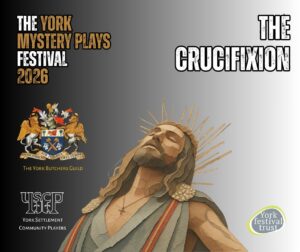
Originally staged by the Pinners, with the Painters or the Latoners
Play no. 35. The soldiers crucify Jesus.
What happens
Four Soldiers have arrived in Calvary. They may be identifiable through costume or behaviour as the ones from the preceding Journey to Calvary. They are in a hurry to get Jesus crucified as he has to be dead by noon. They have their tools ready and set to work.
The plan is to place Jesus on the cross while it’s on the ground. There they can hammer in the nails. Jesus asks forgiveness from God for humanity then settles himself in position for them. Each Soldier takes up position at hands, head and feet. A crown of thorns is pushed on to his head. They quickly find there is a problem: the hole bored at the feet to receive the nail is too far down. The solution is to tie rope to his feet and stretch Jesus until he fits. It takes all four of them to do this, but they succeed.
The next step is to get the cross upright. Again, there is a problem. The mortice, or slot made to receive the cross, is too big and the cross is now too heavy. They settle themselves on either side and at his feet then lift. It’s so hard they have to put him down again. On the second attempt they manage it, only to find that the cross wobbles in its hole. Wedges are hammered in to hold it.
Exhausted, they prepare to leave, then have the idea of drawing straws for his clothes.
Throughout this, Jesus speaks only twice. Once to pray God to forgive them, once to say he endures this to save humanity from sin. Finally, the cross is hoisted into position and drops agonisingly into the mortice hole.
Extract
Let us bear him to yon hill.
4 SOLDIER Then will I here bear down
And attend to his toes until.
2 SOLDIER We two shall see to either side
Or else this work will all go wrong.
3 SOLDIER We are ready; wait good sirs abide!
Let me first his feet grip strong.
2 SOLDIER Why listen ye to these tales all the time?
1 SOLDIER Lift up!
4 SOLDIER Let see!
2 SOLDIER Ow! Lift along!
Why give the play to the Pinners?
Wire pins were essential for fastening the folds in women’s clothing as folds and tucks increased in 14th and 15th century fashions and women were not only the main customer base but often pinners themselves. It was the wealthy who bought the most, inevitably, and in 1400 the Duchess of Orleans bought several thousand in Paris. Similar demand was present in this country too. In York in 1381 ten Pinners are recorded in the tiny parish of St. Crux, not long after the Guild itself formed and members became part of the ‘48’; the Town Council. During the height of the Mystery Plays then, Pinners had importance if not wealth.
In The Crucifixion, no women are named, possibly suggesting a nuanced approach to the play. Women are onlookers who suffer greatly at the sight and in giving this play to a Guild which numbered women (however small that number) amongst its participants (not necessarily members) there seems to be a conscious decision to embrace the wider world which surrounds the event.
Pin manufacture required attention to detail, cost pain as the wires slipped into the skin, and was a back-breaking world in which the body was bent and the eyes straining. In winter the difficulties were even greater. So much about this echoes the masculine world of the play. The soldiers grunt and labour at the work, but their attention to detail is that of experts. Just as their bodies ache, so does that of Jesus, whose flesh receives nails in a terrible expansion of the pinners’ injured fingers. Just as the construction of a pin meant regular form and lengths, so the erection of a cross had to be done in a certain way.
The Pinners’ Crucifixion is a remarkable play given depth and significance by granting it to this Guild. The later combinations with Painters and Latoners (brass-makers) speak more of economic necessity than metaphor. By the mid 15th century pins were being imported in vast quantities and were more cheaply available, causing a rapid demise in the fortunes of the Pinners.
Finding the Action
In this play the cues are about personal actions necessary to make the event run onstage smoothly. This is the second of the two plays which most frequently tell you what to do through cues, concealed and open. The Creation did the same thing.
This play has more implied and explicit cues to action than any other. They prepare the tools, nail him, lift the cross, put it down again, get it up and into its hole, then argue over who should have which of his clothing. There are plenty of more subtle ones suggesting characterisation as well as action.
Many of these plays are rich with implied and written stage directions which in practice are often edited out, reshaped to something else or overlooked by directors. This happens in professional and community productions of Shakespeare and Early Modern plays all the time. Yet everyone who is an actor knows that the dialogue requires you to do what it says or it makes no sense. It’s a strange blindness.
So here is the hidden language of performance, and once you see it you can never un-see it. The point of the cues is that you don’t need a full script – which no actor had – as long as you have your own cues, and if you know the order of events, and you know the shape of the space.
Have fun finding the cues to action in these plays. You are looking for these sorts of things:
- Imperatives (orders)
- Questions
- Rhetorical questions
- Entrances
- Exits
- Visual cues
- Jokes
2026
The Crucifixion is staged by one of the oldest community groups in York: the York Settlement Community Players, and directed by the experienced Maurice Crichton.
It will appear on the two Sundays 28th June and 5th July and again in one or both of the sunset shows.
It is all the more remarkable to watch because of its unique waggon, which belongs to The Company of Butchers of the City of York. Unlike the other waggons which open on a long side (usually the left is preferred and the same has to be used by all participants), this waggon has a short side facing the audience. This puts the audience close to Jesus on all sides and enables the work to be done visibly. There is a different sense of a stage. This is intimate, and the waggon itself is the hill. It is the structure of the waggon which raises the cross and the drop of the wood into the mortice hole jars painfully and visibly.
In medieval times the Butchers did not run The Crucifixion but the following play: The Death and Burial of Christ. However, modern productions commonly extend into this play or put both together. In 2026 the text used is only The Crucifixion.
The York Settlement Community Players
YSCP is York’s community theatre company, entertaining the people of the city and beyond for over 100 years. It has been bringing theatre and communities together since 1919, putting on plays and sharing them with audiences in venues across York, including: York Theatre Royal Studio, John Cooper Studio Theatre @41 Monkgate and The Black Swan Inn.
The Direct Approach project is a regular opportunity for aspiring directors to direct new plays by local writers, all performed by community actors in the relaxed environment of a room in a York pub.
These 30-40 minute plays for between four and five actors are an ideal project to equip new directors with the necessary skills to direct a successful production. Directors are supported throughout by the YSCP committee with planning and publicity, and are also paired with an experienced local director to act as a mentor.
They always welcome new members, whether you are new to theatre or a seasoned professional; opportunities are open to all and there are many ways you can get involved with YSCP.
The Company of Butchers of the City of York
The Company of Butchers of the City of York focuses on:
- Fostering fellowship among Master Butchers and allied trades and professions.
- Preserving the historic traditions and ceremonies of the Company.
- Providing funds for charitable purposes and managing the Company’s Charitable Trust.
In the past, the Butchers, in common with the other Gilds, played a key role in the governance of the City, in the maintenance of trade standards and in the training of apprentices. Charitable and religious occasions were, and are, important. The Butchers produce the ‘Crucifixion’ in the York Mystery Plays.
The Gild welcomes contact with similar bodies worldwide, and with any butchers with a York connection. There are perhaps two hundred Yorks, Yorkes or other derivatives around the globe, are you such a butcher?
https://www.yorkbutchersgild.co.uk
Dr. Alan Heaven
Pageant Master 2026