Originally staged by the Shermen
Play no. 34. Jesus must carry his cross to the place of crucifixion.
What happens
The noise and the press is so great from the crowd that 1 Soldier threatens them with violence to calm them down, reminding them he is a representative of Pilate himself. He warns them that anyone who is seen to support Jesus will be imprisoned so they need to get out of the way. They appear to succeed when the crowd surges and cries out again once they hear Jesus described as ‘a fool king’.
The Soldiers become uncomfortable and look for more men to support them. One of their group, Wymond arrives, and with him is the cross which is ready measured and bored. The Soldiers check their kit and ensure they have hammers, nails and braces to do the job.
The focus returns to the crowd, but specifically to John and 1 Mary, 2 Mary and 3 Mary. The very public grief of all of them is shown in the repetition of ‘alas’ and 2 Mary’s cry ‘O’ and their subsequent wailing is so loud that the Soldiers force them away.
But in the midst of it is a moment of stillness when Jesus, battered and barely able to stand, addresses the ‘daughters of Jerusalem’ which could mean just the three Marys, or could extend to all the women in the crowd. Certainly it is the women who the Soldiers pick on as creating the worst noise. There is a rare clue to the appearance of one of the actors, described as a ‘baldhead with [a] ragged coat’. 3 Mary mops Christ’s face.
The women are described abusively as ‘queans’ (whores) and 2 Soldier jokes their noise is so bad they need throwing in the lake, a traditional punishment for women who get above their place and challenge male authority. The King’s Pool in York was just outside the walls, and the cross may reference the King’s tree by the lake as well as the Holy Tree which Biblically came from a seed on Adam’s tongue, appeared in Moses, David and Solomon and reappeared as the source of the cross.
It is clear that Jesus is fainting with pain and cannot carry the cross. Simon hurries past and is stopped by the Soldiers. After much argument Simon gives in and takes up the cross. He is told to go ahead while the Soldiers turn their attention back to Jesus. They decide he will be led to Calvary naked and that he needs a good beating just for the fun of it. Once the buffeting has happened they take off his clothes and admire the quality. 2 Soldier had been concerned that they were covered in blood, but this doesn’t seem to matter. Finally, they tie him up and lead him off.
Extract
2 SOLDIER Us must have ladders and ropes
To wrench him till he raves,
And nails and other stuff
If we ourselves will save.
1 SOLDIER To tarry long us were but loathe.
If Wymond comes not quick enough
Then we be blamed, all three.
Ay! How! Sir Wymond! How?
3 SOLDIER I am here, what say ye both?
Why cry ye so on me?
I have been getting made
This cross, as ye may see,
Of that place by the lake.
Men called it the king’s tree.
1 SOLDIER Now, truthfully, I thought the same
For that beam will no man us blame:
We cut it for a king.
Why give the play to the Shermen?
This play was originally staged by the Shermen, or shearmen who prepared wool for spinning and weaving. Their primary task was finishing the cloth for weaving, which meant washing, teasing, removing excess fibres and making it ready for production.
The character of Simon here might have been a Sherman, or perhaps their work was shown in the materials on the waggon, as if the journey had paused at their workplace.
There is also a reference to Jesus being ‘clothed’ in items which are good enough for the Soldiers to want to win later on, and an observation that someone’s coat (John’s?) is unfinished and ragged. Clothes feature prominently in the play. At the heart of the decision to give the play to this Guild though, lies the miracle of the linen cloth used by 3 Mary half way through.
3 Mary here is usually known as Veronica, explained below. It will be no surprise to learn that Saint Veronica of Jerusalem is the patron saint of the expert French linen weavers and designers, called mulquiniers.
The Journey to Calvary and Veronica
The Journey has a brutality of the sort which medieval audiences will have already experienced during the trial. It shows the nature of the men who will crucify Jesus and practical planning for a different type of cruelty, preparing us for the coming pragmatic savagery of the Crucifixion.
It also includes a scene which is not in the Bible. The story of Veronica is part of the Christian story of the Stations of the Cross, fourteen moments traditionally represented through art, taken from Christ’s journey to Golgotha. The play itself draws on most of the first ten stations.
I-V are the judgement, bearing the cross, the first fall, the meeting with Mary, and the help from Simon of Cyrene.
VI-X are Veronica, the second fall, the women of Jerusalem, the third fall and being stripped.
The final X-XIV are the nailing to the cross, death, removal and burial, shown in the next plays
So who was Veronica?
Her story is the Vith station and appears first in the apocryphal Gospel of Nicodemus. As Jesus passes by with the cross, Veronica steps out from the crowd and gives him her veil to mop his brow. When it is returned the image of his face has been miraculously imprinted on the cloth. In this play the moment is given to 3 Mary:
Ah lord! Let me clean thy face.
[The cloth is returned]
Behold how he hath shown his grace,
How he is most mighty again!
This sign shall bear witness
Unto all, perpetual, plain:
God’s son is here guiltless
And is put to peerless pain.
2026
This year the play is brought forth by The York Mystery Plays Supporters Trust, directed by former pageant master and medieval music expert Paul Toy.
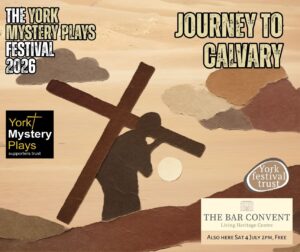
It will appear on the two Sundays 28th June and 5th July and again on Saturday 4th July at the Bar Convent Garden at 2pm. This is free to enter and seating and refreshments will be available. It will not appear in the sunset shows at the Market.
Uniquely amongst the shows, The Journey to Calvary does not include a waggon. This is because of the fundamentally processional nature of the play. It is about a journey and we encouraged Paul’s staging to start from this premise.
The Bar Convent and Veronica
The Bar Convent
In 1686, at a time when it was illegal to be Catholic, a group of religious sisters, now known as the Congregation of Jesus, opened this secret convent. Their foundress was Mary Ward, who pioneered the idea of religious women working as missionaries- part of that mission was to educate girls.
Following Mary’s death, the order founded the first schools for girls in the country – the second in this house.
Today, it is the oldest living convent in the UK. With fascinating exhibitions, a chapel, café, garden and guest house there is something for everyone to enjoy. Open Monday-Saturday, 10am-5pm (last admission 4pm). Closed Sundays.
There are two exhibitions of particular interest in addition to the beautiful Catholic objects and relics: one is Women of The Mystery Plays, celebrating the work of women past and present whose contributions have kept these plays alive. It runs until August 29th.
The second is the reason why The Journey to Calvary is being played here…
Veronica & The Arma Christi
The recently discovered illuminated medieval scroll is known as an Arma Christi, which refers to the images of objects associated with Christ’s journey to the cross. The exhibition features the Bar Convent Arma Christi – the most spectacular of its kind and the only one on public display.
The text is a prayer poem known as ‘O Vernicle’ as it usually shows an image of St Veronica holding the cloth (the Vernicle) at the beginning.
It takes the reader on a journey through the Crucifixion story that focuses on the objects associated with key moments in Christ’s suffering leading up to his death. In the medieval period, these objects were collectively known as the ‘Arma Christi’, the weapons of Christ. These objects are seen as spiritual armour against the temptations of sin.
Up until now, only ten copies were known to have survived, produced in the 14th and 15th centuries, each one handmade by a number of skilled craftsmen. The Bar Convent Arma Christi is thought to be one of the last examples ever made, dating from around 1475.
The ten known scrolls have been subject to academic and ecclesiastical scrutiny for many decades, sharing a unique insight into religious iconography and devotional practices. However, the Bar Convent Arma Christi may turn conventional thinking on its head, as the responses, written in red, demonstrate that this was scroll was likely used in communal worship as well as private prayer.
The Bar Convent Arma Christi is the only one currently on public display in the world. Due to the fragile nature of the Arma Christi scroll, it requires rest periods. During this time it will be replaced by an historically accurate replica. The original will be on display from 22 June – 5 July as part of York Mystery Plays.
https://barconvent.co.uk
The York Mystery Plays Supporters Trust
What does the Trust do?
The YMPST was set up after the 2012 York Mystery Plays 2012 in the Museum Gardens in recognition of the community’s wish to see the Plays continue and to participate in them. They are a charitable incorporated organisation which exists to advance the education of the public in the medieval Mystery Plays of York and supports all performances of the Plays in York.
What is the York Mystery Plays Supporters Trust about?
- Developed a website bringing together all the main sources of information about the Plays and their history
- Produced regular newsletters – read across the globe
- Represented the Plays at conferences and seminars
- Raised funds to support performances of the plays
- Produced its own Waggon Plays in 2014, 2018, 2022 and 2026 as part of York’s Festival Trust’s pageant
- Staged A Nativity for York at the Spurriergate Centre in December 2019 and 2022, then toured the suburbs of York in 2024.
- Organised trips to performances of Plays in other cities and tours of other Mystery Plays, most recently Beverley in 2023
- Worked with the University of York to develop courses and public lectures
- Supported York Minster with the community launch of the 2016 production
Joining the Trust gives you access to the latest information about the Plays and become part of a group of supporters; membership fees (£10 per annum) support the administration of the Trust, enabling fundraising activities to contribute directly to performances.
https://ympst.co.uk/the-york-mystery-plays-supporter-trust
The YMPST has generously offered financial support for the production of the Festival. Its forward-looking Chair, Dr. Emily Hansen, is a co-opted member of the Board of York Festival Trust to enable closer collaboration between the two organisations.
Our grateful thanks both to the YMPST and to The Bar Convent for their unwavering support and donations.
Dr. Alan Heaven
Pageant Master 2026