Originally staged by the Plasterers
This is the second of the York Mystery Plays, and is unusual for having only one speaking role.
What happens
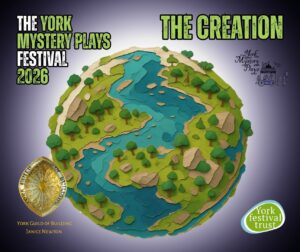
Having created heaven and hell, God turns his attention to Earth.
God reminds everyone that eternal joy is there – but only for those who follow him.
He creates the environment for Adam and Eve over five days.
In the first there was light, so the play begins with sea and sky to take us to the end of the second day. This is followed by land, trees and flowers in the third, and by the sun and moon in the fourth day.
The play ends with the close of the fifth day, creating the animals and bidding them breed, preparing us for the next play in the original sequence: Adam and Eve.
Extract
Since this world is well set out
Forth will I publish my power:
Not through strength but by my shout:
A firmament I bid appear.
Among the waters light as lightning
Their courses truly we can see.
And that same shall be named – heaven
With planets and with clouds all clear.
Why give the play to the Plasterers?
Alongside the carpenters, masons and tile-thatchers they were one of only four building crafts granted guild status. Their work was essential to the building industry as they finished structures internally and externally. The quality of plasterwork in the 16th and 17th centuries indicates the continuing success and reputation of this guild.
The original staging would have reflected the work of the guild, showing off some of its techniques perhaps. They had a significant play and a difficult one because it demanded ways of thinking which did not involve moving people about a space. They had to create something from nothing, much as plasterers do in creating a beautiful surface from a rough one.
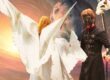
Today this play is owned by the York Guild of Building who continue to be responsible for its production and who have designed the extraordinary tribute to past theatre practice through their waggon. Drawing on pop-up children’s books, 19th century moving flats, and witty special effects they have created a set which comes to life as you watch, perfectly capturing the spirit of joy with which God created the Earth.
The cues
Ever on the lookout for evidence of medieval stagecraft, it was interesting to ask what problems this play posed and if they are still pertinent today. Obviously there is an excess of challenges around making birds, flowers, sun, moon, water and so on, but all of these are resolvable in so many exciting ways. It must have been a marvellous play to see.
What problematic thing is left? That depends on the level of fidelity to the core of what you are depicting.
Let’s think medieval for a moment. This is God the Creator, and whatever staging is used must not undercut that concept. Blasphemy was only a step away all the time (which, incidentally, gives us insight into how they may have approached playing God, Jesus and so on and which we’ll visit in a later piece). So once you make the decision that God’s power must be shown through ‘invisible’ realisation in keeping with divine power – that is, not through stage hands walking on with a bird – then you meet the single unavoidable problem head on.
It is as relevant today as it was then. The same one which medieval performers probably faced: you can’t have God gesture and nothing happen; or worse, something be created before he has commanded it. So how do you know when to operate the trees, open the flaps, squirt the water?
Which is where we can see the stagecraft. You can see it even better in The Crucifixion, where the principle is exactly the same. The solution is this: God tells you what to do. All you have to do is listen. Theatre meets religion!
Take a look back at the extract and you will see that each quatrain (four lines) ends with an instruction:
- A firmament I bid appear.
- With planets and with clouds all clear.
There are plenty more in the play. Try these:
- The water I will be set.
- A flood full fast and clear
- Trees also thereon shall spring
- Greatly will it grow with grass
In case there was any doubt, the text even tells the crew how they will know when to act:
- By my shout
- At my command, as I will bid
The opportunity for metatheatrical games where the audience can laugh or join with the shout occurs several times, and again may give us an indication about the tone of the play. It is not reverential and solemn, but playful and joyous.
If you are lucky enough to catch the director of this year’s production, the lovely Janice, talk to her about how she found the cues and what other techniques she and her invisible crew used to time their actions.
The Firmament
This was originally played as dawn breaks.
It includes the complicated concept of the separation of the water in the firmament. God divide the water into two parts: that which is under the firmament, meaning the seas and rivers, and that which is above, meaning a sky. This could be simply clouds and rain, or it could refer to some vast celestial ocean or barrier far above. Within the gap is a space, the firmament, in which the stars, moon and sun move and land can be formed. The point is, God creates order out of chaos through rules and boundaries.
2026
We’re delighted that the Builders are able to bring forth their brilliant waggon once again, and just as delighted that Janice Barnes-Newton, the director from 2022, has returned to revisit it.
For the first time in a long time though, it is not the opener. This year we are focussing on the binaries of Creation and Destruction as an overarching principle so the creation of earth and the fall of Lucifer in The War in Heaven precedes. An extract from The Creation of Adam and Eve is included in The Fall which follows it so that you can see the narrative of creation from day one to day seven.
We hope you enjoy it.
Don’t hesitate to get in touch, and don’t forget to follow us on Facebook and to sign up for the newsletter. Keep an eye on the website too, ready for the release of the official merchandise and all the latest updates.
Dr. Alan Heaven
Pageant Master 2026