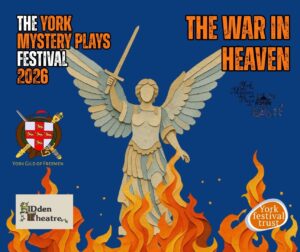
The War in Heaven was originally staged by the Tanners’ Guild.
This is the first of the York Mystery Plays, originally played as dawn breaks.
What happens
God creates Earth, Heaven and Hell. In Heaven he first forms nine orders of angels to live in eternal bliss, as long as they are loyal to him. He names Lucifer Lord of Light and places him above the others.
As the angels worship God, Lucifer’s ambition and vanity grow until he imagines himself ‘receiving reverence’ like God himself on the very highest level.
God casts him down to Hell, along with his followers. Their brightness and beauty are lost and they despair. They blame Lucifer who says it’s their own fault and there is a brawl.
The angels understand why God has done this. He plans to create mankind but first will make Earth a place where their every desire will be realised. He begins by creating night and day.
Extract
O! God! All goes down!
My might and my main are all fading
Help, fellows! In faith! I am falling!
From Heaven on all hand are we hurled
To woe are we wending I fear.
Out! Out! Harrow! Helpless! So hot is it here.
This is a dungeon of dole in which I alight.
What have my kin become, so comely and clear?
Now am I loathsome, alas! that once was so bright.
Why give the play to the Tanners?
The Tanners occupied an unusual position in the guilds of York. On the one hand they were suppliers of raw material from which items ranging from the everyday to the high quality were fashioned. Saddles, bags, shoes, military wear, all were made of leather prepared by the Tanners, also known as the Barkers.
This gave them a fundamental importance to the economy. But just as their play, variously known as The Fall of Lucifer, or The War of the Angels, is composed of two opposite factions, so their social identity had two opposite values. On the one hand, they were an indispensable source providing a service on which many other guilds depended. This gave them a certain cache. On the other hand, they stank.
Tanning is a smelly business, often involving animal urine. Nobody wanted to live next to a tanner with his unprepared animal skins hanging in sheds, and freshly scraped and soaked ones drying in an equally noxious drying house. Valued and unpopular at the same time, the Tanners made the perfect choice for a play featuring exactly that opposition. The good angels versus the bad. God versus the devil.
But best of all, they could provide exactly the right atmosphere for hell. ‘They are fallen into filth’ says God, and to the medieval mind that meant more than just mud.
York in the 16th century, for example, was grim. The 1540 Act for the Re-Edifying of Towns was pertinent for the city as for many others, identifying the causes of squalor as the indiscriminate dumping of animal waste and carcasses, human waste, muck, decaying food and general rubbish – and that was just in the streets. The latrines, open sewers, polluted streams and open ground used for general dumping made the odour and fly infestations even greater. In York, pigs which scavenged freely could not be controlled by the Corporation and the unclean state of the snickets meant vermin had plenty of opportunities to flourish once they had dined on the detritus.
The point is, hell on stage had to mean more than ‘filth’. The play gives clear indications of what was expected. There are references to ‘burning’, ‘our light is now gone’, ‘to spoil thou didst lead us’, ‘our food is but filth’, ‘you choke me in smoke’, ‘in hell to be burnt.’ Fire, smoke, corruption are required. Unlike other plays there is no reference to a hellmouth and no particular need for one, although that doesn’t mean there wasn’t one of course. Lucifer and his followers have to fall downwards, the text is very clear about that, and end in hell immediately. Hell does not exist before that moment. What the Tanners could bring to this was not only the leather and hides which could comprise costume replacements for the white and shining robes of their angelic state, but also odour. Tanning, as we know, meant stink and even if you could shut your doors against dirt, it was hard to keep out a rank smell.
This play was first then, and it was probably the smelliest. God creates perfection, then the stagecraft uses multiple methods to reinforce its opposite. And once that waggon trundled along from its first station, it would trail a stinking line as it went. Since the play only makes sense if the odour can be controlled, it might be that we are getting a glimpse of hidden stage technique here. God can’t claim perfection if the air is pestilential to begin with, nor can the scene return to heaven for the final third if heaven smells like hell, therefore the source of the smell must be able to be capped and closed. Perhaps in a cauldron of some sort.
The journey
It was common practice to strew the streets with rushes before a visit or procession of special significance. The Corpus Christi procession when the sacred host was borne through the streets would probably fit that. There is no certainty that the procession followed the same route as the waggons but what is certain, is that the 48th waggon to roll along Coney Street would have a harder journey than the first. Assuming that Stonegate and Pavement were paved (the names give a clue) then the remainder were packed earth, maybe gravel. If it rained…it could be a very messy journey indeed.
One final note about the play is that it links, with delicious medieval circularity, to the last play, Doomsday, also called The Last Judgement. In this play, there is absolutely a hellmouth because the damned souls are taken through it by the devils. In this case, hell is not onstage, but offstage, on the unknowable but all too vividly imagined Far Side of the Portal. Perhaps the smell returned?
Both the first and the last plays are high on energy and dense with polarities. They pair beautifully. You just had to wait from dawn till sunset (at least) to compare.
2026
In the coming cycle, this play will be brought forth by Laura-Elizabeth Rice and HIDden Theatre who will work with the volunteers who come forward to act and participate. Which could include you.
There will be more about the company and their work later on, but if you want to be involved then this could be a great chance to be part of a high octane opener. The War in Heaven is a terrific short play with visual opportunities throughout. If you want something a bit quieter, then you are always welcome to join one of the others!
Don’t hesitate to get in touch, and don’t forget to follow us on Facebook and to sign up for the newsletter. Keep an eye on the website too, ready for the release of the official merchandise and all the latest updates.
I’d love to hear from you!
Dr Alan Heaven
Pageant Master 2026