Originally staged by the Coopers
Number 5 in the York Mystery Plays Cycle has five roles and a single problem: how do you keep your promise when the alternative is so tempting?
What happens
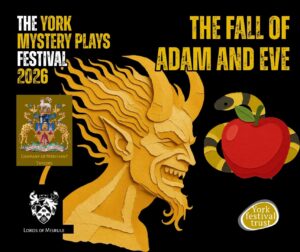
For 2026 we’ve taken the moment from Play no. 3 staged by the Cardmakers in which God creates humanity and dropped it into the main play here: the Fall.
Satan is tormented by God’s refusal to forgive him and is envious of God making Adam. He decides the best vengeance is to ruin mankind. He persuades Eve to eat the fruit of the forbidden tree so that she would have all knowledge and would be worshipped like a god. She does – and persuades Adam to do the same. The consequences are shocking.
Extract
SATAN But [God] has made to him a mate
And hard to her I will me hie:
That ready way.
That purposed plan I’ll push aside
And try to pluck from him this prey.
My work would be well spent
Might I him so betray,
His liking for to end.
Why give the play to the Coopers?
Coopers made barrels, buckets, casks, anything which could hold liquid or dry goods in wood. In the medieval world this was the prime method of storage and safe transport, making the Coopers a greatly valued Guild.
Construction was difficult and skilled, with the trade falling into three areas of specialisation:
- Dry Coopers, whose work held a vast range of foods, goods and materials
- Wet Coopers, who were the most highly regarded and whose casks held wine and any liquids
- White Coopers, who made buckets and everyday items
In 1420 it became law to stamp your mark into every cask, a rule which remained in force until late last century.
So why give this most important of plays to this Guild?
There may be several answers, and you may think of others. None appear to have been written down so all we can do is infer.
First, this play requires wood. It is set in a garden and has a tree at its centre. This may have required skilled building and with the Carpenters taken up with the Resurrection, the Coopers may have been thought a good choice. Certainly they were more prestigious than carpenters, arguably appropriate for the First Man and Woman.
The other reasons are more about metaphor. Barrels hold wet and dry goods and keep them safe. The human body, which is perfect at the start of the play, is about to be corrupted. Tears will flow at the end. The container leaks and the goods are spoiled you might say.
Similarly, this play is about a safe, secure space in which all is kept pure, but ends with its gates open and the once valued goods emptied out.
Metaphor was a standard way of thinking at the time. For a semi-literate society, reading and understanding the symbols in images provided layers of significance.
Challenges for Actors
GOD
GOD has little to do here, but his contrast in attitude is enormous. From his warm entry to his final anger which is so overwhelming that he can no longer speak.
His expulsion of the sinners is done in a fraction of the time it takes him to curse SATAN and the final task given to another. It is as if he cannot bear to look at them.
EVE
Naïve, greedy, easily charmed by persuasive argument and innocent; these are some of the usual readings of EVE. They work well as footprints to follow, because the rest of the role is rich in contrasts.
Before the bite she is one person. Immediately after it she is someone entirely different, and all of it, all of her new and sinful self, is contained in a single word: ‘Adam’.
Nor does she hold back. It is EVE who takes on SATAN’s mantle and becomes the persuader now. Five times EVE insists that ADAM take the fruit.
Shock and realisation come over EVE suddenly when ADAM recoils from what he has done. Now she is full of remorse and tears.
ADAM
ADAM’s attitudes are more strongly drawn than EVE’s. He starts by being angry with her, then confident in his decision to eat, then enraged at her for tricking him. Self-pity follows from this, then shame and finally utter despair.
This is quite a set of contrasts to play and gives us some idea of the demands made on medieval actors and of the quality of the writing.
2026
The play is brought forth through the Company of Merchant Taylors of the City of York, by York University medieval experts: The Lords of Misrule.
Guided by Thomasina, this production features all the elements you would hope to find, especially that show-stopper of images, the serpent.
It will be the third play in the sequence and followed by the last of the Old Testament plays: Noah and the Flood. Through these four plays we are presenting the whole of God’s creations and ending with the first of his destructions.
The Lords of Misrule
If you are interested in historical drama, the Lords of Misrule will be delighted to welcome you.
Based at the Centre for Medieval Studies, University of York, they stage medieval plays three times a year in a range of languages, including Middle English, Old Norse, Old English and even the occasional Latin.
lordsofmisrule@gmail.com or follow on Instagram
The Company of the Merchant Taylors of the City of York
The company traces its origins back to the three medieval guilds of tailors, drapers and hosiers. Tailors appear in the City’s Freemen from 1273, the earliest references to guild organisation are the ordinances and register of members dating from 1387.
In medieval times, the tailors were closely associated with the religious and charitable confraternity of St. John the Baptist, the fraternity that built the present Hall. During this period, the York Tailors enjoyed a golden age, playing a major role in the social and economic life of the City. As one of the leading York City craft guilds, the tailors also played an important role in the famous sequence of York Corpus Christi mystery plays.
Today, the Company uses the income from letting the Hall, endowment funds and Member donations to maintain and preserve the Hall and to support the development of skill and talent of York based young people in the areas of arts, music and crafts. At present they distribute grants totalling approximately £15,000 each year. They have ambition to grow this and welcome your donation to help. The Great Hall and Blue Hall are popular wedding venues.
Membership reflects a diverse range of personal and professional backgrounds. While some members maintain ties to the tailoring industry, others represent various professions, including business, medicine, healthcare, law, academia, public service, and the military. Many also bring valuable experience as trustees for local and national charities.
Whilst the Company’s origins have links to Christianity, it has welcomed people of all faiths for many years and none as members/visitors, and they are committed to creating a diverse and inclusive environment that welcomes and values all who come into our Hall. Membership is very worthwhile: Members see it as both a privilege and a pleasure; they enjoy working together to make the Company a success, fulfil its purpose, and maintain and enjoy its traditions.
To find out more: https://www.merchant-taylors-york.org/about-the-company-of-merchant-taylors-york