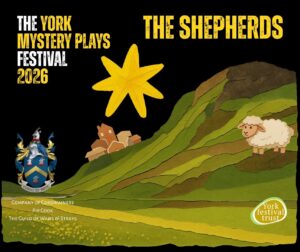
Originally staged by the Chandlers
At Number 15 in the Cycle it is the most musical of the plays.
What happens
The Shepherds are both comical and deeply serious, shifting from one state to the other through the play, just as they escort us from a cold and practical world outside to a warm if simple room indoors; from the cold starlight to the blinding angel light; from merriment through fellowship to a deep joy in encountering Jesus.
Best of all, they sing. Most songs in the Cycle are given to Angels, so it is good to have something of the people. The song affirms their simple rusticity and is set against the purity of the Angel voice.
It is, like so many, a play of journey into spiritual knowledge and a play of binaries. But it’s also funny.
The Shepherds are a crowd-pleasing, popular, join-in-and-have-fun comic trio. The play is preceded by Noah and the Flood which also has comic moments. If Noah and the Flood ends the world, then begins it anew, so does this pageant: the birth of Jesus marks a transformation and a new beginning. It is also the last of the light moments in the 2026 set and is followed by the horror of the Massacre of the Innocents, then the Passion and Doomsday.
Extract
3 SHEPHERD What care is come to thee?
1 SHEPHERD Step forth and stand by me right
And tell me then
If you ever say such a sight.
2 SHEPHERD I? Nay, truly, nor never no man.
3 SHEPHERD Say fellows, what? Find ye any feast?
I surely need my share indeed.
Why give the play to the Chandlers?
Central to city life, the Chandlers supplied candles and soap, commonly of tallow (animal fats) or beeswax. Wax candles were the luxury items.
The choice of this guild to stage the play is because of the time of day. It is night and the hills and Bethlehem are in darkness. For chandlers, this was an opportunity to show off the very best they had. Both the star and the stable need illumination, and beautiful candles and holders to match. Even the quality of their tallow candles used by shepherds and in inns could be promoted.
It is interesting that the same code is used in these plays that is used for the next few hundred years: night is signalled by the holding of candle or lantern and the audience is entirely happy with making that imaginative leap.
Location, location
There are at least two locations: the hills where most of the action takes place, then on to Bethlehem and from there into the stable. Much the simplest solution might be for Bethlehem and the stable to be on the waggon and the hills to be on the ground. This would allow the Angel some extra height (above it maybe?) and associates Jesus with a higher plane, working symbolically as well as practically.
The transition between these places tells us something about the staging practice of the time. Underlined are the location references:
Go we thereby
Him to honour
And make mirth and melody
With song to seek our saviour.
Et tunc cantant. And all sing.
1 SHEPHERD Brother, be all blithe and glad,
Here is the place that we should be.
2 SHEPHERD In that same spot now do we stand,
Therefore I will go seek and see.
Such luck in life never shepherds had.
Look, here is the house. And here is he.
They head for Bethlehem, specifically to the spot where the Angel was singing. The journey is covered by a song. Imagining they had to climb to a waggon, it has plenty of opportunity for heights and dramatic ordering of three figures as they sing out.
Next, they are exactly where the Angel stood. But now it gets tricky. 2 Shepherd is going to take a journey. Within three lines he travels from the Angel spot to an ‘unseen’ house and inside. And possibly all of it on a waggon top of maybe six metres long.
This is a world of symbolism. Everything about the plays stands for something other. A journey can be a single pace. A house can have a baby in a manger and be invisible until announced. Everything is more than it seems to be and to the medieval mind these distances and conceits don’t matter. The statement of location defines it and the use gives each its religious purpose.
In this, the sense of sharing of the plays with the audience stands out. They know the story and don’t need literal representation to get it. The realism is in the emotional world, the interactions, the spoken word. The spiritual significance is in the location, the action, the visual representation, the music, the familiar icons. This binary nature of the Cycle, and the world of opposites, polarities, contrasts on which every play is constructed shouts out in The Shepherds. Look at the contrasting characterisation; the indoor/outdoor settings; the angelic and natural types of light; the comedy against the emotional truth.
2026
Director Pip Cook’s take on The Shepherds promises to be an outstanding and joyous experience. Songs and sheep, hills and a stable, and a vibrant, fast-moving playing style.
Pip is a professional actor who has lived in York for the past few years and will be working with a tight group of performers to realise the play.
She is also working with and for the Company of Cordwainers, an ancient Guild of York which made leather shoes and boots.
The Company of Cordwainers
The core objectives of the men and women of the Company of Cordwainers of the City of York are
- To promote and encourage knowledge and interest in design, creation, manufacture, repair, distribution and marketing of footwear and industries associated therewith.
- To revive and continue to promote interest in the origins, activities, ordinances, objectives and attainments of the original Cordwainers dissolved in 1808 and revived in 1977.
- To establish contacts and exchange information with other Companies or Guilds at home and abroad.
The Company of Cordwainers is one of the seven ancient York Guilds in existence in the 21st century. The Guilds, founded in the medieval period or earlier, have retained traditions that stretch back into the mists of time and greatly add to the rich pattern of life in the City of York.
Cordwainers were workers in ‘cordwan’ a type of fine shoe leather that originated from the Spanish city of Cordoba, the primary source of such leathers in medieval times. This fine leather was made from goatskins, which is represented on the Company’s Coat of Arms which includes three goat heads plus a fourth as a crest.
In the past, the Cordwainers, in common with the other Guilds, had key roles both in the governing of the City, maintenance of trade standards, training apprentices and taking lead roles in social and religious activities such as the medieval Passion Plays performed on waggons around the city on Corpus Christi Day and now known worldwide as the York Mystery Plays.
The earliest reference to the Cordwainer trade in York comes from the Freemen’s Rolls for 1272-3 in which ‘Thomas de Fulford, Cordwainer’ is the first entry.
If you want to know more, contact https://yorkcordwainers.org.uk/
The Cordwainers’ own play The Agony and Betrayal in the Garden will be released as part of the ongoing project to record all 48 plays in the York Cycle.
If you want to be involved in audio recordings as an actor (especially if you’re local with a local accent!) please get in touch. All are welcome, professional status not required.
Dr. Alan Heaven
Pageant Master 2026