Originally staged by the Girdlers & Nailers
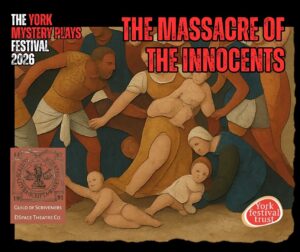
Of the several brutal plays in the York Mystery Cycle, this one is often the most upsetting to witness.
What happens
Herod is silencing the crowd of people about him with the reminder that if they serve him, they serve his deity too, who is not God. His councillors calm him down and ask how they may please him. The reason for Herod’s bad mood becomes clear: three Kings passed through in search of a boy king but have not returned. Herod wants to know where he is.
A messenger arrives with news. The Kings found the boy, whose name is Jesus, and have returned home. Herod rages at the messenger until he leaves angrily. Herod does not know what to do, but his councillors have the answer: kill every boy in Bethlehem under two years’ old.
The soldiers swear to do this and set off. In the town they are stopped by the mothers who beg them to spare the babies. They do not. The soldiers return to Herod with the good news. except they were not told how to identify Jesus so can’t confirm if he is dead. Herod is furious and sets off to find him.
Extract
1 SOLDIER Come forth fellows! Appear.
Look: foundlings find we here.
1 MOTHER Out on you! Thieves I cry.
You have slain my seemly son.
2 SOLDIER These brats shall dearly pay,
The bale has just begun.
Now lay to – and fast.
2 MOTHER Alas for dole I die
To save my son shall I
Aye, while my life may last.
Why give the play to the Girdlers & Nailers?
The former made the metalwork of buckles and clasps; the latter forged nails. Both were highly skilled crafts. Combining them brought together two sides shown in the play: the female position, since the Girdlers made items worn by women as well as men and could be seen as having a domestic quality to them appropriate for Mothers. And the male position, given by the Nailers, whose unbending, penetrative, sharp-pointed products not only prefigured the crucifixion but also could here be seen to represent the weapons used to kill the babies.
It is a painful connection which shows how the Corpus Christi plays have to be understood beyond their texts. Their meaning extends into the streets, the architecture, the textures and the people of York, back into the players and out into the audience, embracing everyone in one collective story. Here, everything means. Staging this today, at a time of such horror in the world, is justifiable only if it is seen as part of a journey towards hope and better treatment of our fellows. That is the ultimate message of these plays and as good a reason for continuing to stage them as any other.
The Massacre of the Innocents origins
Versions of the play appear in the four most complete cycles extant: N-Town, Chester and Coventry, making it a scene from the Bible which was accorded particular significance in medieval times.
It can be found in Matthew 2: 16-18, which the King James Bible reports like this:
16 Then Herod, when he saw that he was mocked of the wise men, was exceeding wroth, and sent forth, and slew all the children that were in Bethlehem, and in all the coasts thereof, from two years old and under, according to the time which he had diligently inquired of the wise men.
17 Then was fulfilled that which was spoken by Jeremiah the prophet, saying,
18 In Rama was there a voice heard, lamentation, and weeping, and great mourning, Rachel weeping for her children, and would not be comforted, because they are not.
As with so much in the New Testament, it has a parallel in the Old and was commonly read this way. Jeremiah 31:15 offers a prophecy:
Thus saith the Lord; A voice was heard in Ramah, lamentation, and bitter weeping; Rahel [sic] weeping for her children refused to be comforted for her children, because they were not.
So is there any historical truth in this? Unfortunately, Josephus says nothing about it which means it could well be untrue, but he does have plenty to say about Herod’s cruelty.
In 40 BC the Senate crowned Herod ‘King of the Jews’ and loaned him a Roman army to capture Jerusalem, which he did. He then promptly executed his predecessors, the Hasmonean dynasty, and those who supported them. Then he moved on to his teenaged brother in law, the High Priest, who was drowned in the swimming pool at Jericho. This murder was soon followed by that of his mother in law and of his second (and allegedly favourite) wife, also a Hasmonean.
Twenty years or rule did little to win him popularity however, so he played a classic two pronged attack: on the one side was a new and meticulous network of well-paid spies who helped him remove anyone who spoke against him. On the other was a whopping 33% reduction in taxes for all citizens.
Still it was not enough to make his reign secure, so in 7BC he strangled his sons by that late favourite wife, and followed them immediately by killing 300 military high commanders in case they turned against him. A prophecy that he would be usurped seemed to haunt him. Which may be why the prospect of a coming King would have been enough to send him slaughtering any possible candidates. His last act was to kill his eldest son Antipater in 6BC, which was around the time of Christ’s birth. He died a few days later, but had prepared a special method of making sure the world mourned for him: he summoned all Jews in authority from across the kingdom to Jericho then locked them in the hippodrome, instructing his soldiers to kill them all upon his own death. In the end, his siter Salome cancelled the instruction.
Herod the Wicked makes the perfect villainous foil in the Mystery Plays and this scene, whether real or not, is in line with his behaviour. More importantly, it had dramatic significance for the unity of the plays and resonates powerfully as a reminder to those in power how easily they can get things wrong and what the human cost is.
2026
This year the play is brought forth by DSpace, York’s Ukrainian theatre company. It is directed by Dara Klymenko working with the York Guild of Scriveners.
It sits in contrast to the preceding pageants: Noah and the Flood, which includes a comedy Wife and eventual optimism about a better future, and The Shepherds, a play with a light touch and several songs but which treats the birth of Jesus with solemnity and touching honesty. The love shown for mothers and children in these plays makes the demolition of this in The Massacre even more powerful.
The position of the play in the 2026 sequence also marks a shift in tone ready for the further darkness ahead, as we prepare for The Journey to Calvary, The Crucifixion and the ultimate end which is Doomsday.
We hope you enjoy it and are moved by it.
DSpace and The Guild of Scriveners
Together they will bring forth the play, with the DSpace actors actively helped by members of the Guild.
DSpace
This theatre company is a supportive community group for children and adults to express themselves through theatre. The group provides a creative space for displaced Ukrainians, with members meeting weekly to rehearse.
Dara Klymenko is the director and recent plays have included There’s No Clock in the Forest and Sign of the Times.
‘The main goal is to create a safe and inspiring space for self-expression. I call it a space for inspiration’ says Dara of the group’s working practice.
The Guild of Scriveners of the City of York
Established in 1487 and still part of the city’s life today, the Guild celebrates the history and traditions of the written and printed word in Yorkshire from medieval times to the present day.
There is always a warm welcome for new members, whether lawyer or journalist, writer or accountant, teacher or historian, writer or academic or other professionals who work with words and are the ‘scribes’ of today and who wish to maintain the Guild’s traditions established over 500 years ago for people like them.
Being a Scrivener today is first and foremost about enjoying the company of like-minded people at a small number of relaxed social and entertaining educational events across the year whilst also maintaining the traditional charitable aspect of Medieval Guilds and linking with other historic Guilds in the City of York.
Their home in York is the delightful medieval Bedern Hall, a perfect and atmospheric venue for dining by candlelight to celebrate special moments on the Guild calendar such as the annual ‘Court Dinner’, the ‘Yorkshire Day Supper’ and the annual history-themed presentation and dinner.
Why not join the scriveners and enjoy making history and heritage come alive as a member of one of York’s traditional medieval guilds?
Dr. Alan Heaven
Pageant Master 2026